
Table of Contents
ToggleVintage Woodard patio furniture represents a golden era of American outdoor living, when wrought iron and aluminum pieces were built to last generations. For collectors, restorers, and design enthusiasts, original Woodard catalogs serve as both historical documents and practical restoration guides. These catalogs document the craftsmanship, design evolution, and finishing techniques that made Woodard a household name from the 1930s through the 1980s. Whether someone’s inheriting a set from a grandparent or hunting for mid-century pieces at estate sales, understanding what to look for, and how to verify authenticity, can mean the difference between a valuable find and a costly mistake.
Key Takeaways
- Original vintage Woodard patio furniture catalogs from 1950–1975 document authentic design specifications, finish colors, and construction details essential for restoration and authentication, with complete catalogs worth $50–$200 depending on rarity.
- Authentic vintage Woodard pieces are identified by manufacturer marks stamped on frames, hand-forged scrollwork with slight variations, heavy-gauge aluminum construction, and thick baked-enamel finishes that distinguish them from modern reproductions.
- Professional powder coating at $150–$300 per piece provides the most durable restoration option for vintage Woodard patio furniture, delivering superior corrosion resistance and UV stability that matches original finishes.
- Estate sales, architectural salvage yards, and online marketplaces offer the best sourcing opportunities for vintage Woodard furniture, with four-piece conversation sets in good condition typically priced between $400–$1,200.
- Proper maintenance of vintage Woodard patio furniture—including monthly hosing, prompt paint touch-ups, and indoor cushion storage—preserves both functionality and value, ensuring these mid-century pieces serve reliably for generations.
The Legacy of Woodard Patio Furniture
Lyman Woodard founded the Woodard Furniture Company in Owosso, Michigan, in 1866, initially producing wicker baby carriages. By the 1920s, the company shifted focus to outdoor furniture, pioneering techniques in wrought iron fabrication that would define American patio design for decades.
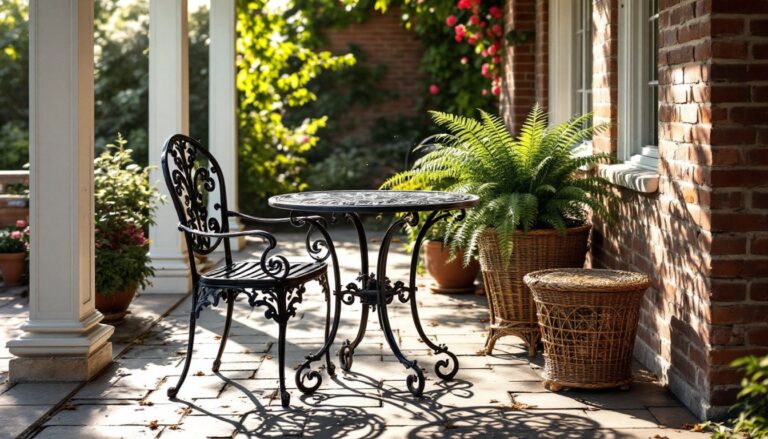
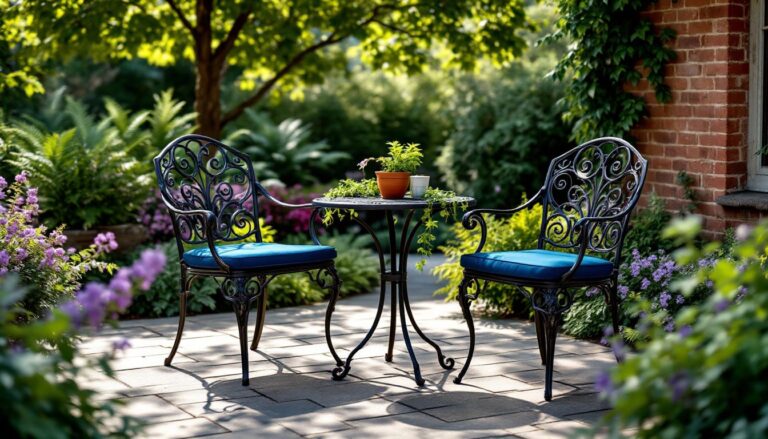
Woodard’s breakthrough came with their chantilly rose pattern and other ornamental designs that combined structural integrity with decorative appeal. Unlike stamped or welded competitors, Woodard used hand-forged wrought iron and later proprietary aluminum alloys, applying multiple coats of baked-on enamel that resisted rust and UV degradation.
The company’s mid-century modern lines, including Sculptura (designed by Russell Woodard in the 1950s) and Andalusian patterns, became staples in outdoor entertaining ideas across postwar America. Production continued in Michigan until overseas manufacturing shifted much of the industry in the 1990s. Original American-made pieces from the 1930s–1980s remain highly sought after for their durability and design integrity.
Catalogs from this era showcase not just furniture styles but the evolution of outdoor living as a concept, from simple wrought iron benches to fully coordinated conversation sets with spring-motion chairs and matching side tables.
What Makes Vintage Woodard Catalogs Valuable
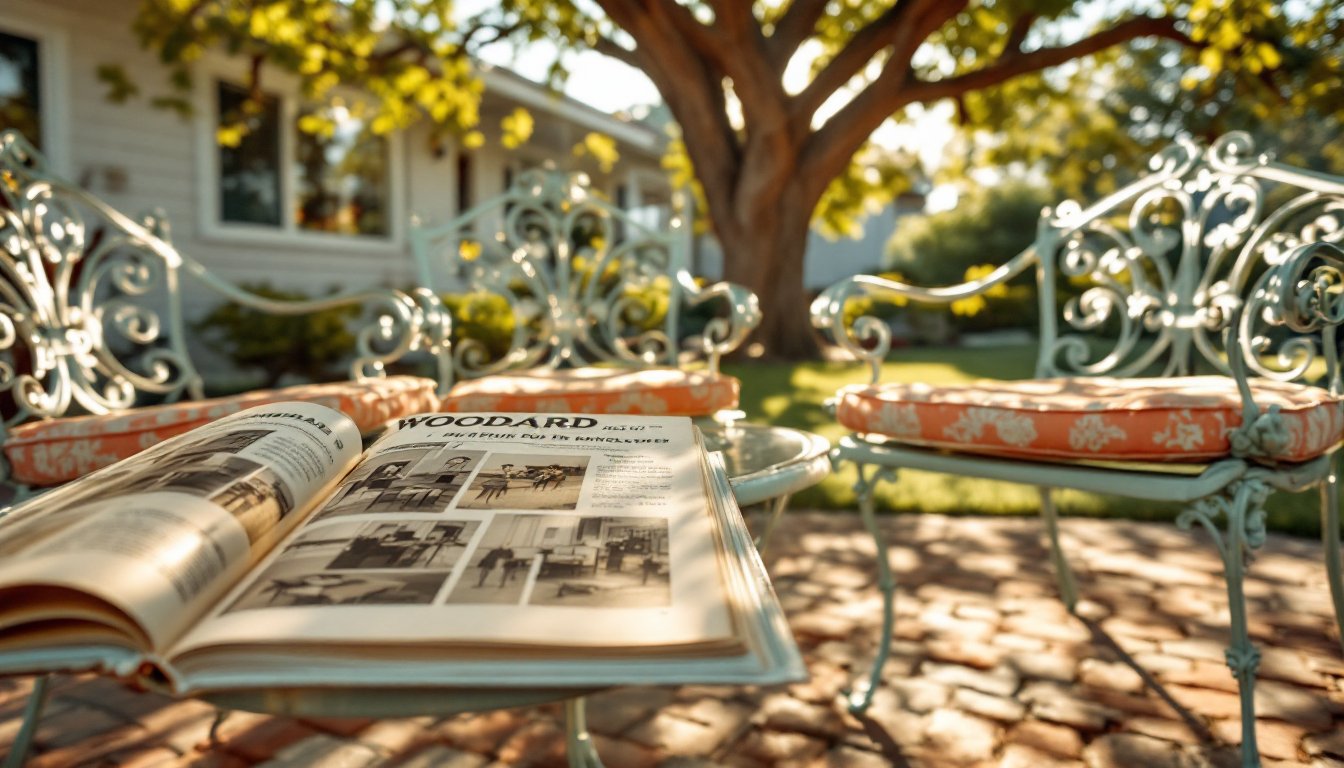
Original Woodard catalogs serve multiple practical purposes beyond nostalgia. Restorers rely on them to identify correct finish colors (Woodard used specific enamel formulations like “Mayfair Green” and “Sedona Red”), verify original cushion patterns, and source replacement parts that match period-correct specifications.
Catalogs typically included:
- Full pattern names and item numbers for each piece
- Dimensional specifications for frames, seat heights, and table diameters
- Finish options with color swatches or photography
- Cushion fabric choices and construction details
- Retail pricing (useful for historical context and valuation)
Collectors value catalogs from 1950–1975 most highly, as this period covers Woodard’s most iconic designs and the transition from wrought iron to aluminum. Complete catalogs in good condition can sell for $50–$200, depending on year and rarity. Design libraries and restoration shops often maintain reference copies for professional use.
For anyone restoring an inherited set or verifying authenticity before purchase, a period-correct catalog provides documentation that online research can’t match, especially for discontinued patterns or limited-production runs.
How to Identify Authentic Vintage Woodard Pieces
Authentication requires checking several physical characteristics. Genuine Woodard furniture from the American production era exhibits specific construction details and quality markers that knock-offs lack.
Signature Design Elements and Manufacturing Marks
Woodard pieces made before 1990 typically carry a manufacturer’s mark stamped or cast into the frame. Look for:
- “Woodard” or “Woodard Furniture Co.” stamped on the underside of chair seats, table aprons, or leg joints
- Patent numbers or “Made in USA” markings on wrought iron pieces
- Cast aluminum tags riveted to frames on later models
Construction quality provides additional clues. Authentic Woodard wrought iron features hand-forged scrollwork with slight variations between pieces, machine-stamped reproductions show identical repetition. Welds should be smooth and minimal: Woodard used forge-welding techniques that integrate joints rather than surface-welding.
Finish quality matters. Original baked enamel coatings are thick, smooth, and typically show age-appropriate wear patterns, not flaking or bubbling like inferior spray paint. Multiple layers are visible in chipped areas.
For aluminum pieces (common after 1960), check wall thickness. Woodard used heavy-gauge aluminum (approximately 1/8″ wall thickness on structural members), substantially heavier than modern patio furniture. Lift the piece, vintage Woodard aluminum has noticeable heft compared to contemporary imports.
Spring-action chairs and gliders should have robust coil springs mounted in reinforced cradles, not simple S-hooks. Original cushion frames used continuous wire edge construction rather than separate piping.
Where to Find Vintage Woodard Catalogs and Furniture
Sourcing original catalogs and furniture requires patience and multiple channels. Estate sales and auctions remain the most productive hunting grounds, particularly in the Midwest and regions with established porch and outdoor living ideas where Woodard furniture was popular.
For Catalogs:
- eBay and Etsy list vintage catalogs regularly: search for specific years or pattern names
- AbeBooks and antiquarian book dealers occasionally stock furniture trade catalogs
- Local library archives (especially in Michigan) may have reference copies available for digitization
- Facebook Marketplace and collector groups dedicated to vintage patio furniture
For Furniture:
- Estate sales and estate auctions in established neighborhoods (1950s–1970s subdivisions)
- Habitat for Humanity ReStores and architectural salvage yards
- Craigslist and Facebook Marketplace (search “Woodard,” “wrought iron patio,” “vintage patio furniture”)
- 1stDibs and Chairish for higher-end authenticated pieces (expect premium pricing)
Pricing varies wildly based on condition, pattern rarity, and regional demand. A four-piece vintage Woodard conversation set in good condition typically runs $400–$1,200. Rare patterns like Sculptura or complete dining sets command higher prices. Factor in restoration costs, professional powder coating runs $150–$300 per piece, custom cushions $200–$400 per set.
Best finds come from sellers who don’t recognize the Woodard name. Search generic terms and inspect photos for manufacturing marks before asking questions.
Restoring and Maintaining Your Vintage Woodard Furniture
Proper restoration preserves both function and value. Stripping and refinishing vintage Woodard requires different approaches depending on material and intended use.
Surface Preparation:
Start by assessing the existing finish. If the original enamel is intact with only minor rust spots, spot-treat rather than strip completely. Use a wire brush or 80-grit sandpaper to remove loose paint and surface rust. For heavier corrosion on wrought iron, a wire wheel on an angle grinder works faster but requires care around delicate scrollwork.
Complete stripping requires chemical stripper (aircraft remover for baked enamel) or sandblasting. Sandblasting provides the cleanest surface but should be done by professionals to avoid warping thin metal or damaging decorative elements. Always wear chemical-resistant gloves, safety goggles, and a respirator when using strippers, fumes are hazardous in enclosed spaces.
Refinishing:
For long-term durability, powder coating by a professional shop provides the closest match to original Woodard finishes. It costs more ($150–$300 per piece) but offers superior corrosion resistance and UV stability. Specify semi-gloss or satin finish to match vintage appearance.
DIY refinishing works for budget projects. After stripping and surface prep:
- Apply rust-inhibiting primer (zinc-chromate or epoxy primer) in two coats
- Finish with high-quality outdoor enamel (Rust-Oleum or Valspar) in 2–3 light coats
- Allow 72 hours cure time before use
Structural Repairs:
Broken welds require MIG or TIG welding, not a DIY job for most homeowners. Find a metal fabricator experienced with ornamental ironwork. Spring mechanisms can often be rehabilitated by cleaning, lubricating with white lithium grease, and replacing worn mounting hardware.
Cushions and Fabric:
Original cushion covers rarely survive outdoor use. Custom replacements should use solution-dyed acrylic fabric (Sunbrella is the standard) over high-density foam (minimum 5 lb density for seating, 2 lb for backs). Most upholstery shops can replicate vintage cushion construction with box-edge style and welted seams.
For maintenance, hose down frames monthly during use season, touch up paint chips promptly, and store cushions indoors or in weatherproof bins. Properly maintained Woodard furniture will outlast its owner, these pieces were built when outdoor living spaces were designed for permanence, not seasonal replacement.
Conclusion
Vintage Woodard catalogs and furniture represent a convergence of American manufacturing quality and mid-century design sensibility that’s increasingly rare. Whether someone’s restoring a family heirloom or building a collection from scratch, understanding authentication markers, sourcing strategies, and proper restoration techniques ensures these pieces serve another generation. The investment in time and materials pays off in furniture that functions as well as it did seventy years ago, and appreciates in both value and character with age.