
Table of Contents
ToggleBuilding pallet patio furniture offers a practical way to furnish an outdoor space without spending hundreds on store-bought sets. Wooden shipping pallets, often available free or cheap from warehouses, hardware stores, and distribution centers, can be transformed into functional seating, tables, and loungers with basic carpentry skills and a weekend’s effort. This guide walks through the process from selecting safe pallets to finishing techniques that stand up to sun and rain, helping DIYers create durable outdoor pieces that look intentional, not scrappy.
Key Takeaways
- Pallet patio furniture offers significant cost savings—a DIY pallet sofa can replace a $400–$700 store-bought sectional for under $50 in materials.
- Only heat-treated (HT) pallets are safe for furniture; always check for the IPPC stamp and avoid pallets marked ‘MB’ or showing signs of chemical contamination, oil stains, or mold.
- Proper finishing is essential for outdoor durability—weatherproofing with stain, spar urethane, paint, or natural oils prevents warping, graying, and rot within a single season.
- Key tools for most pallet patio furniture projects include a circular saw, drill/driver, orbital sander, safety gear, and exterior-grade wood screws for structural integrity.
- Adding cushions, armrests, and refined details like glass tops or LED lighting transforms basic pallet wood into inviting outdoor seating that matches intentional design rather than appearing DIY.
- Proper maintenance—storing cushions indoors, resealing annually, and sanding between finish coats—ensures pallet furniture remains functional and attractive for years.
Why Build Pallet Patio Furniture?
The cost savings are immediate. A single pallet sofa can replace a $400–$700 outdoor sectional, and the materials budget rarely tops $50 when factoring in fasteners, sandpaper, and finish. Beyond price, pallet projects teach fundamental woodworking skills, cutting, sanding, fastening, finishing, without the risk of ruining expensive lumber.
Pallets offer modular design flexibility. Standard GMA pallets (48″ × 40″) and EUR pallets (47.2″ × 31.5″) provide consistent starting dimensions, making it easier to scale projects or match pieces. The rustic aesthetic suits a range of patio styles, from industrial-modern to farmhouse casual.
Environmentally, reclaiming pallets diverts wood from landfills. Many businesses discard pallets after a single shipment cycle, so sourcing them reduces waste while keeping material costs near zero. But, not all pallets are safe for furniture, more on that in the next section.
Choosing and Preparing the Right Pallets
Heat-treated (HT) pallets are the only safe choice for furniture. Look for the IPPC stamp, usually burned into a stringer or block. It will read “HT” for heat treatment, indicating the wood was kiln-dried to kill pests without chemicals. Avoid pallets stamped “MB” (methyl bromide), which were fumigated with a toxic pesticide banned in many countries but still in circulation.
Steer clear of pallets with oil stains, chemical odors, or visible mold. These may have carried hazardous materials, petroleum products, pesticides, food waste, and aren’t worth the health risk. Grocery store pallets often carry food residue that attracts pests: distribution centers and hardware stores are cleaner sources.
Inspect for structural integrity before hauling them home. Reject pallets with cracked stringers, broken deck boards, or protruding nails that indicate rough handling. Warped or twisted frames won’t sit level and are frustrating to work with.
Prep begins with disassembly or cleaning:
- Disassemble carefully. Use a pry bar and hammer to separate deck boards from stringers. Work slowly to avoid splitting the wood. A reciprocating saw or oscillating multitool can cut through nails flush if boards won’t budge.
- Remove all fasteners. Pull nails with a cat’s paw or nail puller. Leaving even one creates a hazard for saw blades and hands.
- Pressure wash or scrub. Blast off dirt, splinters, and grime. Let the wood dry completely, 48 to 72 hours, before cutting or sanding. Wet wood clogs sandpaper and causes uneven cuts.
- Sand thoroughly. Start with 80-grit to knock down rough spots and weathering, then move to 120-grit for smoothness. An orbital sander speeds the process: hand-sanding works but takes hours. Always wear a dust mask, pallet wood harbors dirt, mold spores, and who-knows-what from its past life.
Essential Tools and Materials You’ll Need
Most pallet furniture projects require a core set of tools. DIYers likely own some already: others are worth borrowing or renting if the project is a one-off.
Tools:
- Circular saw or miter saw. A circular saw handles breakdown cuts: a miter saw gives cleaner angles for armrests and trim.
- Drill/driver with bits. Use a corded or 18V cordless model. Countersink bits prevent splitting and give a cleaner finish.
- Orbital sander. Speeds surface prep dramatically. Hand-sanding is possible but exhausting on large projects.
- Pry bar and hammer. Essential for disassembly.
- Tape measure, carpenter’s square, and pencil. Accurate layout prevents crooked cuts and misaligned frames.
- Safety gear. Safety glasses, dust mask, work gloves, and ear protection are non-negotiable. Pallet wood throws splinters and dust: power tools are loud.
Materials:
- Wood screws. Use 2½″ to 3″ exterior-grade screws for structural joints. Avoid nails, they don’t hold as securely and can back out over time.
- Wood glue. Titebond III or another waterproof formula adds strength to joints that will see moisture.
- Sandpaper or sanding discs. Stock 80-grit, 120-grit, and 220-grit for progressive smoothing.
- Finish. Options include exterior stain, deck sealer, or paint. Linseed oil or tung oil penetrate deeply and highlight grain but require annual reapplication. Spar urethane offers more durable UV and moisture protection.
- Cushions or outdoor fabric. Bare pallet seating is uncomfortable for more than a few minutes. Outdoor-rated foam (dense, quick-drying) and solution-dyed acrylic fabric (Sunbrella is the go-to brand) resist fading and mildew.
Popular Pallet Patio Furniture Projects to Try
Pallet Lounge Chairs and Sofas
A basic two-pallet sofa is the entry-level project. Stack two pallets, one as the base, one as the backrest, and join them with 3″ wood screws driven through the base into the backrest stringers at a 10–15° recline angle. Reinforce the joint with L-brackets on the inside for added strength.
For a longer sectional, align three or four pallets end-to-end for the seating platform and attach a continuous backrest using pallet deck boards ripped to width. Use a circular saw with a rip guide to cut boards down to 12–14″ for a comfortable back height. Secure with screws every 8–10″.
Adding armrests elevates the look. Cut pallet stringers to length (typically 24–26″) and fasten them vertically to the front corners, then cap with a deck board ripped to 4–5″ width. Sand edges heavily to avoid splinters.
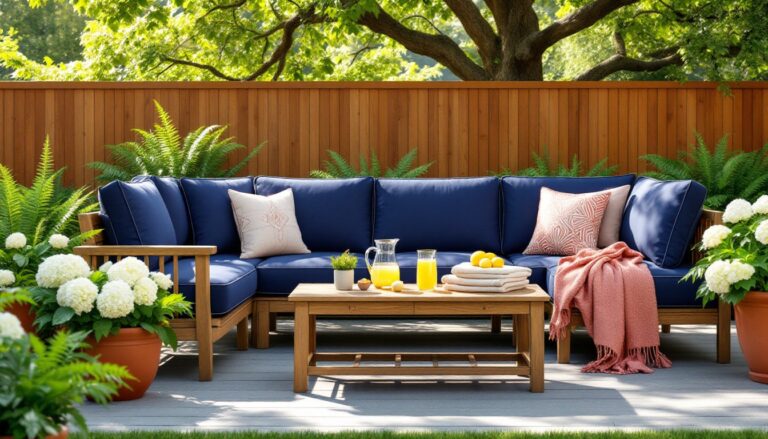
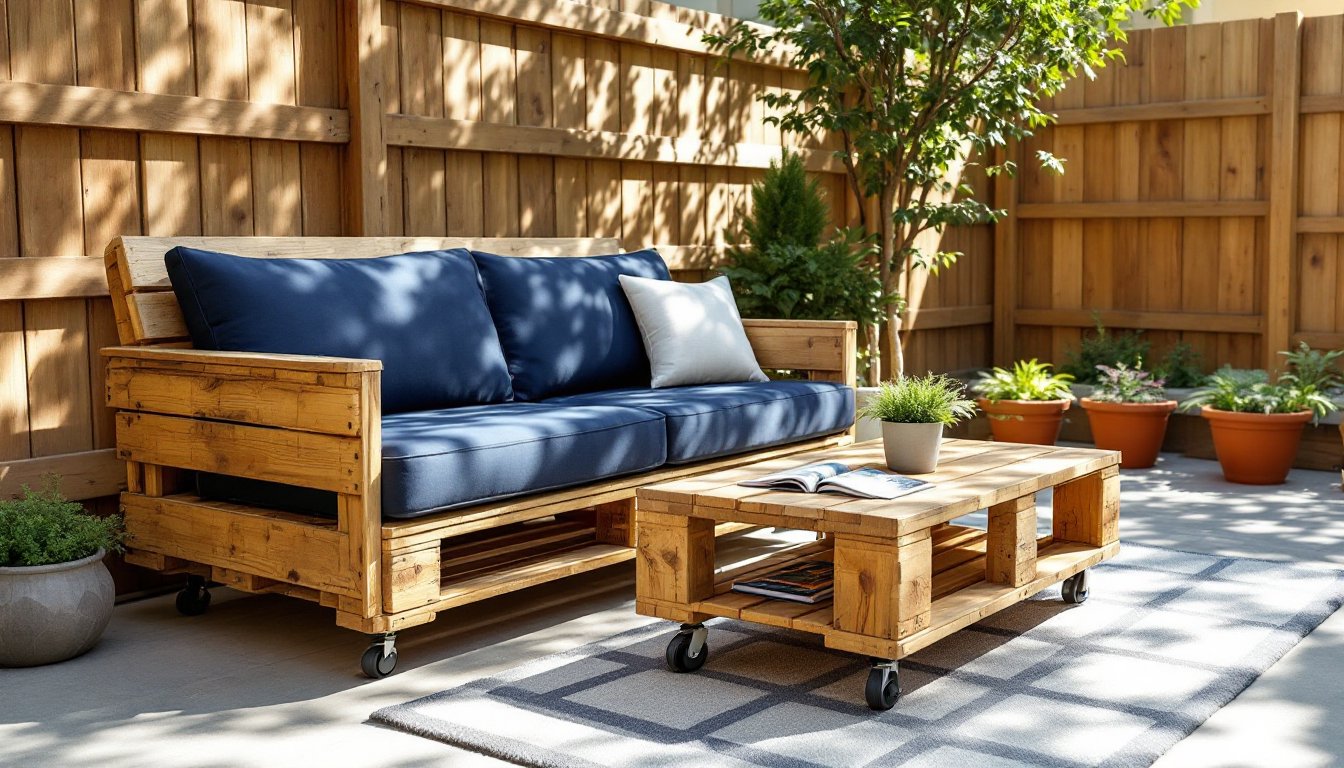
Finish with 4″-thick outdoor cushions. Measure the seating area carefully, standard pallets yield roughly 40″ × 48″ seating surfaces, but layout shifts if you’ve trimmed boards. Many creative pallet furniture designs show how cushions transform raw wood into inviting seating.
Pallet Coffee Tables and Side Tables
A single-pallet coffee table is the simplest build. Sand, stain, and add four caster wheels (rated for at least 100 lbs each) to the bottom corners, or build a base from 4×4 legs cut to 16–18″. The pallet deck becomes the top: the cavity between deck boards and stringers offers built-in storage for magazines or outdoor gear.
For a more refined look, cover the top with a sheet of ¾″ plywood or tempered glass cut to size. Attach plywood with 1¼″ screws from below: glass sits on adhesive bumpers or clips. The smooth surface is easier to clean and eliminates gaps where small items fall through.
A side table uses half a pallet (cut crosswise through the center stringers with a circular saw) mounted on 18–22″ legs. Use 2×4 lumber for legs, attaching them with corner braces or pocket screws drilled through the stringers. Step-by-step guides on maker platforms walk through joinery options in detail.
Tip: Adding a bottom shelf between legs (another set of pallet deck boards) increases stability and usable space. Fasten the shelf 6–8″ above ground level to keep items off dirt or wet pavement.
Finishing, Weatherproofing, and Styling Your Creations
Raw pallet wood will gray, warp, and rot within a season if left unprotected. Finishing isn’t optional for outdoor furniture, it’s the difference between a project that lasts years and one that disintegrates by fall.
Staining and sealing is the most popular approach. Apply an exterior wood stain (oil-based penetrates deeper: water-based cleans up easier) with a brush or rag, working with the grain. Let it dry per the manufacturer’s instructions (usually 4–24 hours), then topcoat with spar urethane or exterior polyurethane in two coats. Sand lightly with 220-grit between coats for better adhesion.
Painting works well for a clean, modern look. Prime with an exterior wood primer (blocks tannin bleed and improves paint adhesion), then apply two coats of exterior latex or acrylic paint. Light colors reflect heat: dark colors absorb it and can become uncomfortably hot in direct sun.
Natural oils like linseed or tung oil soak into the wood, enhancing grain and providing moderate water resistance. They require reapplication every 6–12 months and won’t hold up as long as film-forming finishes, but they’re easy to touch up and maintain a natural appearance.
Don’t skip end grain. Cut ends absorb moisture faster than face grain. Brush extra sealer or paint onto any exposed ends to prevent rot from creeping into joints.
Once finished, style the furniture with weather-resistant accessories. Outdoor rugs define seating zones and add color. String lights or solar lanterns create ambiance without electrical work. Throw pillows in fade-resistant fabrics tie the space together, just bring them inside during heavy rain to extend their life.
Store cushions indoors or in a deck box when not in use. Even waterproof covers trap moisture underneath, leading to mildew. If leaving furniture outside year-round, apply a fresh coat of sealer each spring. Various outdoor project ideas demonstrate finishing techniques that hold up across different climates.
Pallet furniture won’t match the precision of manufactured pieces, but that’s part of the appeal. The slight irregularities, visible grain, and knowledge that it was built by hand give it character that cookie-cutter patio sets lack, and at a fraction of the cost.