
Table of Contents
ToggleHalf moon patio furniture brings a distinct architectural curve to outdoor spaces that conventional rectangular or square pieces can’t match. These crescent-shaped sets, whether sofas, sectionals, or dining arrangements, wrap around fire pits, planters, or conversation areas, creating natural gathering zones without harsh corners. They’re particularly useful for smaller patios where maximizing seating without blocking sightlines matters. If a homeowner wants furniture that feels intentional rather than just arranged, half moon designs offer that built-in flow. Here’s what to know about choosing, arranging, and maintaining these curved pieces.
Key Takeaways
- Half moon patio furniture maximizes seating efficiency by wrapping around a central focal point like a fire pit, allowing more guests to fit in smaller outdoor spaces without blocking sightlines.
- Choose high-density polyethylene (HDPE) synthetic wicker with powder-coated aluminum frames for durability, UV resistance, and low maintenance in most weather conditions.
- Position your half moon furniture set with the open side facing your primary view or entry point, ensuring at least 18–24 inches of legroom around the focal point and 36 inches of clearance to doorways and high-traffic areas.
- Teak and acacia hardwoods offer natural weather resistance for curved wood frames, though teak requires minimal maintenance while acacia needs annual sealing with penetrating oil.
- Monthly cleaning with mild soap and water, annual frame inspections for stress cracks, and proper off-season storage of cushions will extend the lifespan of half moon patio furniture significantly.
- The curved design of half moon furniture creates an intentional, cohesive aesthetic that softens geometric hardscape elements and naturally encourages face-to-face conversation without sharp corners.
What Is Half Moon Patio Furniture?
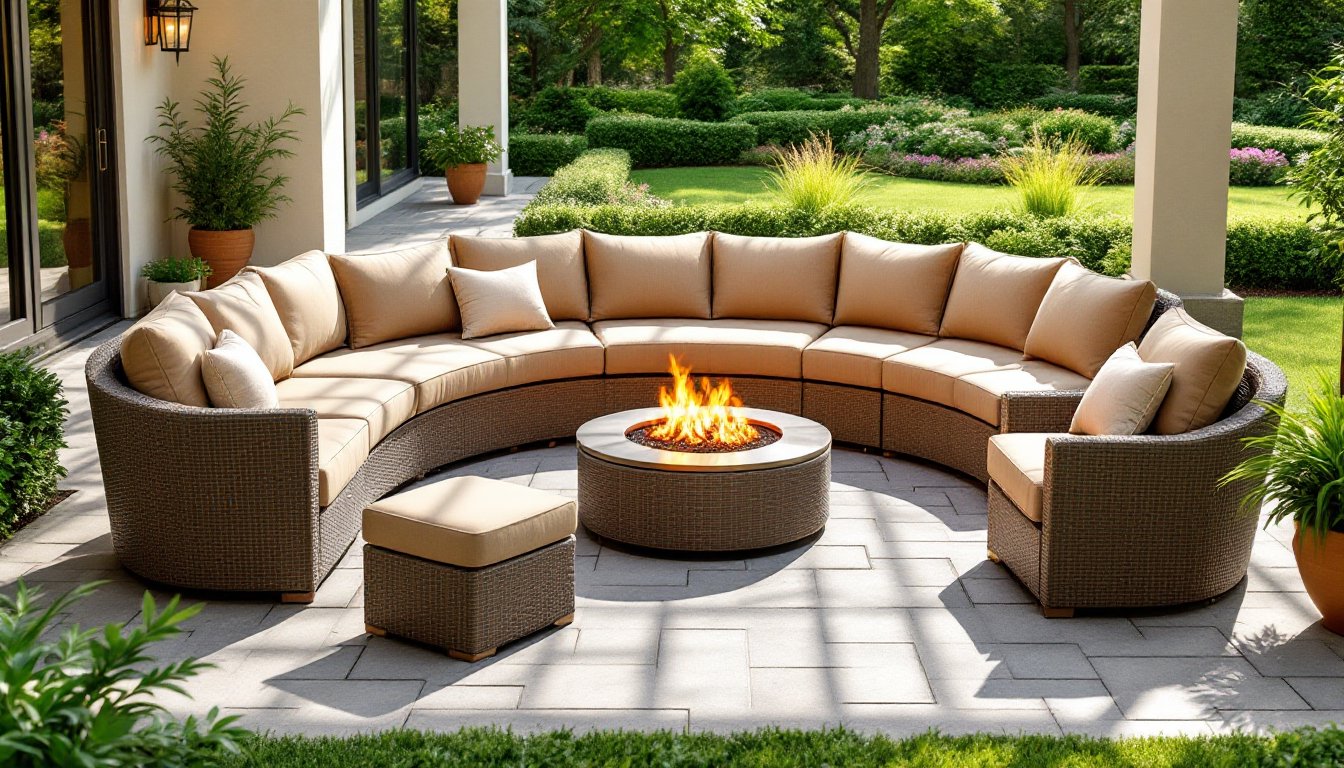
Half moon patio furniture refers to any outdoor seating or table set shaped in a crescent or semicircular arc. The most common configuration is a curved sectional sofa that wraps around a central focal point, typically a fire table, coffee table, or planter. Some sets include matching ottomans or side tables that follow the same radius.
Unlike modular sectionals with sharp 90-degree corners, half moon pieces have continuous curved frames. Seat depth typically runs 24–30 inches, and the overall arc can span anywhere from 6 to 12 feet in diameter depending on the set. Most use a steel or aluminum frame wrapped in wicker, rattan, or slatted wood.
You’ll also find half moon dining sets where chairs arc around a circular or oval table, though these are less common in the DIY retail space. The curved layout naturally encourages conversation and face-to-face seating without anyone stuck at the “end” of a straight bench.
The shape works best when there’s a clear centerpiece to wrap around. Without that anchor, whether it’s a fire feature, low table, or even a large potted plant, the curve can feel arbitrary. Think of it as designing around a hub rather than against a wall.
Why Choose Half Moon Furniture for Your Patio
Space efficiency is the primary draw. A half moon set fits more people in less square footage than a traditional L-shaped sectional because the curve tucks seating into a tighter footprint. For a 10×12-foot patio, a six-seat half moon can replace what would otherwise require an 8-foot straight sofa plus additional chairs.
The design also improves sightlines. On a deck or patio that overlooks a yard, garden, or view, no one ends up facing a fence or wall. Everyone in the arc naturally angles toward the center and outward, which works well for entertaining or just enjoying the space.
Traffic flow benefits too. Because there are no sharp corners jutting into walkways, a curved set creates a more intuitive path around the seating area. This matters on smaller patios where every foot counts, or when the furniture sits near a doorway or grill station.
From a design perspective, the curve softens hardscape elements. Patios are often made of rigid pavers, concrete slabs, or decking, all straight lines and right angles. A half moon set introduces an organic counterpoint without requiring major landscaping changes. Many outdoor living ideas incorporate curved furniture layouts to break up geometric hardscaping.
Finally, half moon furniture signals intentionality. It doesn’t look like someone just pushed a few chairs together. The unified curve reads as a cohesive design choice, which can elevate the overall look of an outdoor space even if the rest of the yard is still a work in progress.
Popular Half Moon Patio Furniture Styles and Materials
Wicker and Rattan Half Moon Sets
All-weather wicker (synthetic resin wicker) is the most common material for half moon patio sets. It’s UV-resistant, won’t splinter, and handles moisture better than natural rattan. Look for high-density polyethylene (HDPE) wicker over cheaper PVC versions, it’s more durable and less prone to fading.
These sets typically feature a powder-coated aluminum frame underneath the wicker weave. Aluminum won’t rust and keeps the overall weight manageable, which helps if the furniture needs to be moved for cleaning or storage. Frame gauge should be at least 1.2mm thick for structural integrity: anything thinner may flex or warp under load.
Cushions are usually 4–6 inches thick with quick-dry foam cores wrapped in water-resistant fabric (often polyester with a Sunbrella or similar acrylic coating). Check that cushion covers have YKK or similarly robust zippers, cheap zippers fail first, and replacement covers can cost as much as budget furniture.
Natural rattan and wicker are occasionally used for covered patios or screened porches. They offer a more organic aesthetic but require more maintenance and aren’t suitable for exposure to rain or direct sun over time. If the patio lacks a roof or pergola, stick with synthetic.
Many retailers now offer half moon chairs inspired by midcentury curved dining pieces, which can complement or contrast with sectional sets depending on the overall style.
Metal and Wood Half Moon Options
Steel and wrought iron half moon sets are less common but durable. Look for powder-coated steel with a minimum coating thickness of 60–80 microns to prevent rust, especially in humid or coastal areas. These sets are heavier, often 200+ pounds for a four-seat arc, which can be a plus for wind resistance but a drawback for rearranging.
Welded joints are preferable to bolted connections on curved metal frames. The constant stress from the arc shape can loosen bolts over time, requiring periodic retightening. If bolted, ensure hardware is stainless steel (not zinc-plated) to avoid corrosion.
Teak and acacia are the go-to hardwoods for curved outdoor furniture. Both have natural oils that resist moisture and insects. Teak is the premium choice, it weathers to a silver-gray patina and can last 20+ years with minimal maintenance. Acacia is more affordable but requires annual sealing with a penetrating oil-based sealer (not film-forming varnish, which will peel).
Curved wood frames are typically made by steam-bending thin laminations or cutting from wide planks. Steam-bent pieces are lighter but may telegraph joints or gaps after a few seasons of expansion and contraction. Solid-cut frames are more stable but generate more waste and cost more.
Avoid pressure-treated pine or fir for curved pieces. The lumber’s natural tendency to warp makes it unsuitable for maintaining a consistent arc, and the chemical treatment can leach onto cushions or skin in hot weather.
How to Arrange Half Moon Furniture on Your Patio
Start by identifying the focal point. This is what the arc will wrap around. Common choices include a round fire pit (36–48 inches in diameter), a circular coffee table, or a large planter. Measure the diameter of that centerpiece, then add 18–24 inches on all sides for comfortable legroom and access. That sum is the minimum diameter your half moon set needs to enclose.
For example, a 42-inch fire table needs at least 78 inches (6.5 feet) of clearance, so look for a half moon set with an inner radius of roughly 39 inches and an outer radius of 63 inches. Most manufacturers list inner and outer arc measurements in product specs, use those to avoid guesswork.
Orientation matters. On a rectangular patio, position the arc so the open side faces the primary entry point or view. If the patio overlooks a yard or landscape, aim the open end toward that sightline. If the set backs up to a house or fence, the closed side should nestle against that boundary to maximize usable space in front.
For L-shaped or irregularly shaped patios, place the half moon in the wider section. Trying to jam a curve into a narrow side yard or tight corner defeats the purpose, you’ll lose the spatial efficiency and create awkward dead zones.
Anchoring isn’t always necessary, but on exposed decks or windy sites, consider furniture weights (sandbag-style bases that slip under the frame) or non-permanent tie-downs using adjustable straps anchored to deck posts or railing. Don’t drill through composite decking without consulting the manufacturer’s guidelines, as it may void warranties.
Leave at least 36 inches between the outer edge of the furniture and any grill, doorway, or other high-traffic feature. This is the minimum clearance for comfortable passage per residential design standards, and it prevents bottlenecks during gatherings.
If adding side tables or ottomans, keep them within the arc rather than breaking the curve. Placing a rectangular side table outside the crescent disrupts the visual flow and creates a tripping hazard.
Maintenance Tips for Half Moon Patio Furniture
Synthetic wicker: Hose down monthly to remove pollen, dust, and bird droppings. For stubborn grime, use a soft-bristle brush and a solution of 1 tablespoon dish soap per gallon of water. Avoid pressure washers, they can fray the wicker weave or force water into the frame, leading to internal corrosion. Dry with a microfiber cloth or let air-dry completely before replacing cushions.
Inspect the frame annually for stress cracks at the curve’s apex, where bending forces concentrate. Small cracks in powder coating can be touched up with appliance epoxy paint in a matching color to prevent rust from starting underneath.
Metal frames: Wipe down steel or aluminum frames with a damp cloth every few weeks. If rust spots appear on steel (even powder-coated), sand lightly with 220-grit sandpaper, apply a rust-inhibiting primer, and touch up with matching paint. Aluminum may develop white oxidation, remove it with a paste of baking soda and water, rinse, and dry.
Lubricate any moving parts (adjustable legs, reclining mechanisms) with silicone spray lubricant, not WD-40, which attracts dust.
Wood: Teak can be left untreated to develop its gray patina, or maintained with teak oil applied once or twice per season. Acacia and other hardwoods need annual sealing. Sand lightly with 120-grit paper to open the grain, wipe clean, and apply penetrating oil sealer (like linseed or tung oil blends) with a foam brush. Two thin coats beat one thick coat.
Check curved joints for movement or gaps. Wood expands and contracts with humidity, which can loosen joinery over time. Tighten any loose bolts and apply exterior wood glue to gaps if needed. If the furniture is mortise-and-tenon construction, re-gluing requires disassembly, consider a pro if you’re not comfortable with that.
Cushions: Store indoors or in a deck box when not in use for extended periods (weeks, not days). Even “all-weather” fabrics degrade faster under constant UV and moisture exposure. Spot-clean spills immediately with mild soap and cold water. For deeper cleaning, most covers are machine-washable on gentle cycle with cold water, air dry only. Never put foam cores in the washer.
If mildew appears, mix 1 cup white vinegar with 1 gallon water and scrub with a brush. For stubborn mold, use a solution of 1 part bleach to 4 parts water, but test on an inconspicuous spot first, bleach can fade some fabrics.
Winterizing: In climates with freeze-thaw cycles, bring cushions indoors and cover the frame with a breathable furniture cover (not plastic tarps, which trap condensation). Elevate the furniture slightly with blocks or risers to keep it off wet ground or snow, which prevents moisture wicking into the frame.
In milder regions, homeowners often leave half moon sets out year-round. For design inspiration and seasonal outdoor living ideas, consider regional approaches to patio maintenance and styling that account for local weather patterns.